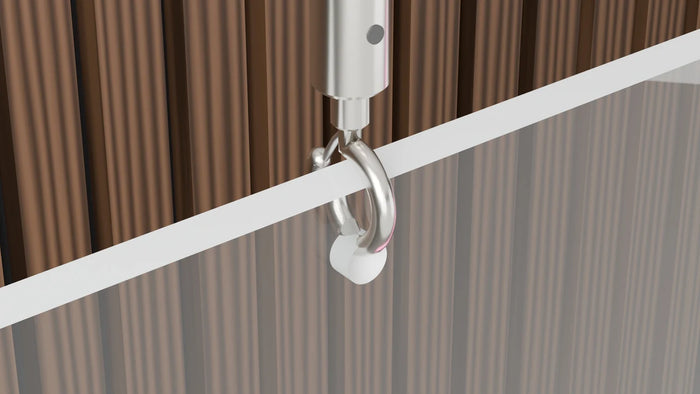
The question is not which method is best, it is what your sign weighs and what your wall is made of. Adhesive hooks are fine for smaller pieces and stop being fine at a weight most people guess wrong.
A rough guide: a 60 by 30 cm sign is around 1.5 kg, a 90 by 45 cm is around 3.4 kg, and a 120 by 60 cm is around 6 kg. Above roughly 3 kg, or on any wall you cannot trust, use fixings rather than adhesive.
Start with the weight, because nobody publishes it
Almost every guide to hanging a neon sign says to use adhesive hooks and stops there, without saying what the sign weighs or what the hooks are rated for. Those two numbers are the whole decision.
| Overall size | Approximate weight | Sensible method |
|---|---|---|
| 40 x 20 cm | Around 0.7 kg | Adhesive hooks fine on sound paint |
| 60 x 30 cm | Around 1.5 kg | Adhesive fine, or screws for peace of mind |
| 90 x 45 cm | Around 3.4 kg | Fixings recommended |
| 120 x 60 cm | Around 6 kg | Fixings, and find something solid |
Compare that against what adhesive hooks are actually rated for. Heavy duty adhesive picture strips top out in the region of a few kilograms per set under ideal conditions, on a clean, sound, painted surface. That covers small and medium signs comfortably and runs out well before a 120 cm piece.
What your wall will take
- ✓ Plasterboard or drywall. Adhesive works for light signs on sound paint. For anything heavier, use proper cavity anchors, or find a stud and screw into it.
- ✓ Plaster over masonry. Drill and plug. Reliable but you are committing to the position.
- ✓ Brick or concrete. Masonry bit and plugs. The strongest option and the most work.
- ✗ Tile, glass, textured or freshly painted surfaces. Adhesive is unreliable on all of these. Fresh paint in particular needs weeks to cure before anything sticks to it properly.
The mounting hardware supplied with the sign, and the options available, are covered on the installation options page.
Hanging it, step by step
- Decide the height first. For a sign read while standing, centring it around eye level generally works. Above a sofa or bed, leave roughly 20 to 30 cm of clear wall between the furniture and the bottom of the sign so it reads as a separate object.
- Mark the outline with masking tape and live with it for a few hours. This is the same test that catches sizing mistakes, and it catches placement mistakes too.
- Check where the cable will run before you drill anything. This is the step people skip and regret.
- Mark the fixing points from the sign's mounting holes, not by eye. Measure between them on the sign itself.
- Check level before final tightening. A neon sign a degree off level is very noticeable, because the eye reads the horizontal of the backboard.
- Connect and test before you tidy the cable, so you are not undoing cable management to fix a connection.
Hiding the cable, which is what actually spoils the look
A well hung sign with a cable dangling down the middle of the wall looks unfinished, and this is the most common complaint we hear after installation rather than during it.
Four approaches, roughly in order of effort:
- ✓ Route it to the nearest vertical edge, a corner, a door frame, the edge of a shelf, and drop it there rather than down the open wall.
- ✓ Adhesive cable clips in the wall color, spaced evenly. Cheap and surprisingly effective.
- ✓ Paintable trunking if the run is long and straight.
- ✓ Through the wall to an outlet or a junction behind, which is the cleanest result and the only one that needs planning before you buy.
If you want the cable hidden entirely, tell us at quote stage. Cable exit position is something we can place, and it is far easier to specify than to work around afterwards. Cords, clips and spare adapters are on the accessories page.
Three mistakes worth avoiding
Hanging it before testing it. Power the sign up on the floor first. Finding a fault after it is on the wall turns a five minute conversation into an afternoon.
Trusting adhesive on fresh paint. Paint needs weeks to fully cure, and adhesive failures on recently decorated walls are the single most common way a sign ends up on the floor.
Drilling before finding the cable route. Plan the cable and the fixings together, not in that order.
Outdoors is a different job
An exterior installation needs a sign built for it, weather-rated connections and a suitable supply. Our outdoor signs are built and tested to IP67 and we can supply the test report. What matters here is that an indoor sign cannot be made outdoor-safe by how you mount it, and drilling or extending the cable entry on a finished sign defeats whatever sealing it has. Specify outdoor at quote stage.
If something is not right
If the sign does not light once it is up, the cause is almost always in the power chain rather than the sign. Work through the troubleshooting guide before taking it down again, and contact us if it is not one of the usual suspects.
Frequently asked questions
How much does a neon sign weigh?
As a planning guide, calculated from a 6 mm acrylic backboard plus tube and wiring: roughly 0.7 kg at 40 by 20 cm, 1.5 kg at 60 by 30 cm, 3.4 kg at 90 by 45 cm and around 6 kg at 120 by 60 cm. A cut-to-shape backboard weighs roughly half to two thirds of a full rectangle at the same overall size. We can confirm the actual weight of a specific piece at quote stage.
Can I hang a neon sign with adhesive hooks?
For smaller signs on a clean, sound, painted surface, yes. Heavy duty adhesive picture strips are rated in the region of a few kilograms per set under ideal conditions, which covers small and medium signs and runs out before larger ones. Above roughly 3 kg, or on tile, glass, textured or freshly painted surfaces, use proper fixings instead.
How high should a neon sign be hung?
For a sign read while standing, centring it around eye level generally works. Above a sofa or bed, leave roughly 20 to 30 cm of clear wall between the furniture and the bottom of the sign so it reads as its own object rather than as part of the furniture. Mark the outline with masking tape and live with it for a few hours before drilling.
How do I hide the cable on a neon sign?
Route it to the nearest vertical edge such as a corner or door frame rather than down the open wall, use adhesive cable clips in the wall color, run paintable trunking for long straight runs, or take it through the wall to an outlet behind, which is the cleanest result. If you want it fully concealed, mention it at quote stage, because the cable exit position can be placed for you on a made-to-order sign.
Why did my adhesive hooks fail?
Most often because the paint had not fully cured. Fresh paint needs weeks before adhesive bonds to it reliably, and recently decorated walls are the most common cause of a sign coming down. Textured surfaces, tile, glass and dusty or previously cleaned-with-polish walls are the other usual reasons. On any of those, use fixings rather than adhesive. If a sign was damaged in the fall, the warranty covers free repair.
We have made neon since 1998, and we still make it ourselves. If something here does not answer your question, ask us.