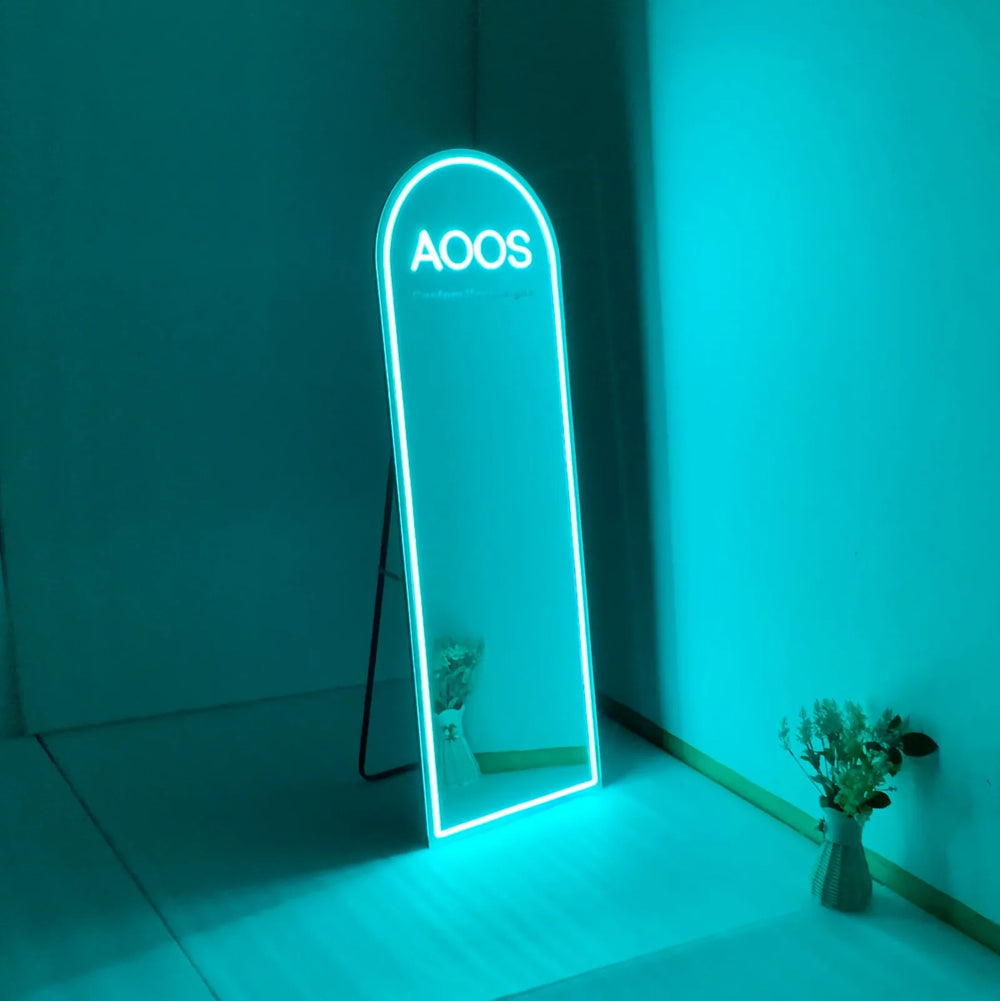
A free standing sign needs no wall fixing at all, which makes it the answer for rentals, venues that forbid drilling, events, and anything that has to move.
The trade offs are footprint, a visible cable across the floor, and stability. All three are manageable if you plan for them.
When free standing is the right call
- ✓ Rentals. No holes, no adhesive, nothing to make good when you leave.
- ✓ Venues. Many will not permit anything drilled and some allow nothing hung at all.
- ✓ Events and hire. Packs down, travels, sets up anywhere in minutes.
- ✓ Walls that cannot take a fixing. Textured wallpaper, crumbling plaster, glass partitions.
- ✓ When you are not sure yet. Live with it in three positions before committing to one.
The honest trade offs
| Consideration | Wall mounted | Free standing |
|---|---|---|
| Floor space used | None | Real, and often underestimated |
| Cable | Can run down a wall discreetly | Crosses the floor. Plan the route |
| Stability | Fixed | Can be knocked. Keep it out of traffic |
| Moving it | New holes | Pick it up |
| Height | Anywhere you like | Low, so it reads as an object not a sign |
The cable is the real design problem
A wall sign hides its cable down the wall behind furniture. A floor sign's cable crosses open floor to reach an outlet, and that is both a trip hazard and the least attractive part of the installation.

Solve it by placing the sign near an outlet rather than near the perfect wall, running the cable along a skirting board rather than across the middle of a room, and using a cable cover where it has to cross a walkway. At an event, a USB power bank removes the cable entirely: a 60 cm sign runs roughly 4 to 5 hours on a USB power bank, and half brightness roughly doubles that.
Stability and children
A free standing sign can be knocked over, and that is the one genuine risk it carries that a wall sign does not. Keep it out of walkways, behind furniture where possible, and away from where children play or a dog turns around. In a home with small children, a wall fixing is the safer choice even if it means making good later.

Free standing is genuinely the better choice more often than people assume, particularly for renters and for anyone who moves house every few years. Just be honest about the cable before you buy, because that is the part nobody pictures and the part everyone ends up living with.
Frequently asked questions
Can a neon sign stand on the floor?
Yes, either on a stand with feet holding the board upright, or leaning against a wall on the floor or a shelf. Neither needs any wall fixing, which makes it the standard answer for rentals, venues that forbid drilling, and events.
Is a free standing sign stable?
On a proper stand, yes, but it can be knocked over in a way a wall sign cannot. Keep it out of walkways and away from where children play or pets turn around. In a home with small children we would use a wall fixing instead, even if it means making good later.
What do I do about the cable on a floor sign?
Place the sign near an outlet rather than near the ideal wall, run the cable along a skirting board rather than across open floor, and use a cover where it must cross a walkway. At an event, a USB power bank removes the cable entirely for 4 to 5 hours on a 60 cm sign.
Does wording need to change for a floor sign?
It helps. A floor level sign is read from above rather than head on, so short wide wording reads much better than tall or multi line wording. Tell us it is for a stand when you order and we will lay it out accordingly.
Can I switch a wall sign to a stand later?
Ask us before ordering rather than afterwards. The cable exit position is built into the sign and cannot be moved, and a stand usually wants a bottom exit while a wall mount usually wants a side or rear one.
We have made neon since 1998, and we still make it ourselves. If something here does not answer your question, ask us.