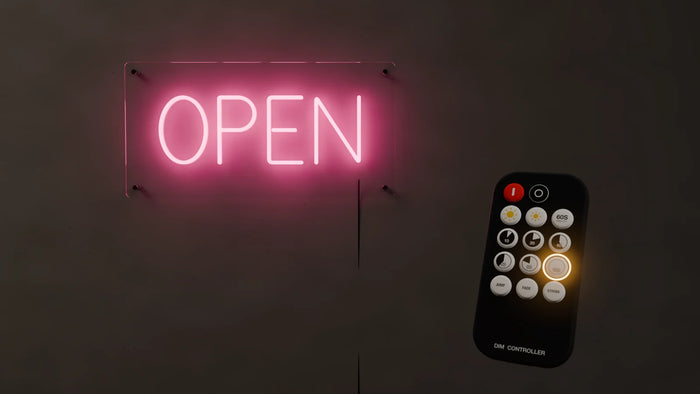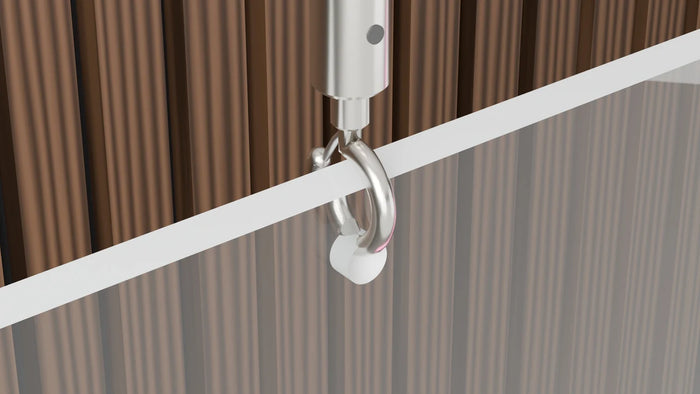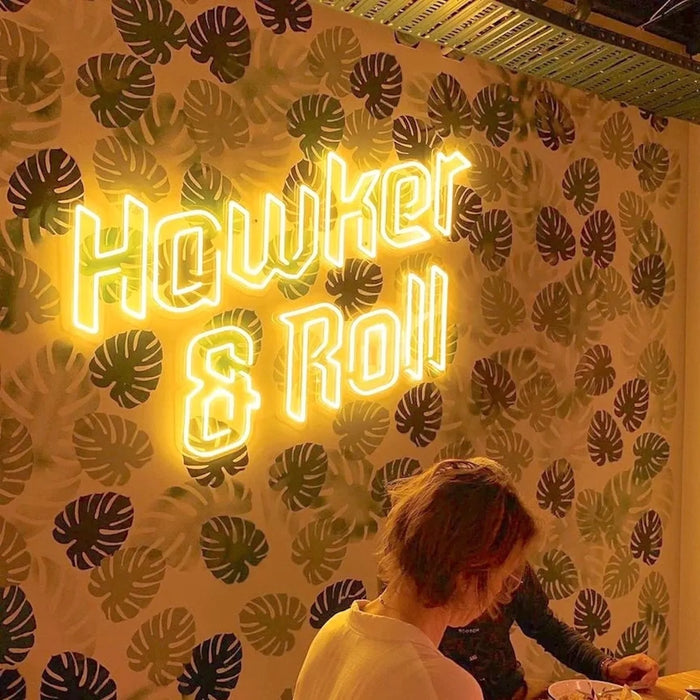
A flexible silicone jacket with a strip of LEDs inside it, running on 12V DC. No glass, no gas, no high voltage.
The jacket is the clever part. It diffuses the individual LEDs into one continuous line of light, which is the entire reason the material can be bent into letters.
What is in the tube
The core. A narrow circuit board carrying LEDs at close spacing, plus resistors to set the current. This is the light source.
The jacket. Extruded silicone, typically 6mm or 8mm across, sometimes 10mm. It is translucent rather than clear, and that translucency is what turns a row of points into a stroke of light. It is also what makes the tube flexible enough to bend without cracking and tough enough to survive being handled.
The ends. Sealed with silicone caps and adhesive. On an outdoor build this sealing is done to a higher standard and tested to IP67.
White tube and colored tube
There are two kinds of jacket, and the default is not the obvious one.
| White jacket (our default) | Colored jacket (to order) | |
|---|---|---|
| Switched off | Frosted white, whatever color it lights | Its own color, matt, like a printed finish |
| Switched on | Brightest and most even | Noticeably dimmer |
| How to order | Standard | Enquiry only |
We default to white jacket because it is simply brighter. Tinting the silicone means the light has to fight its way through a filter, and you lose output for the sake of how it looks with the power off. If that trade is one you want to make, ask us and we will quote it.
How it is powered
Mains goes into a UL listed adapter, which steps it down to 12V DC. Everything past the adapter is low voltage, which is why the tube is safe to touch and barely warm. An in line dimmer sits between the adapter and the sign, and is included on every piece.
How long it lasts
Rated at 50,000 hours. Left on eight hours a day that is roughly seventeen years. There is nothing to service: no gas to replenish, no starter, no electrode to burn out. LEDs dim very gradually rather than failing suddenly, so a sign at end of life is a slightly softer version of itself rather than a dead one.
In practice the part most likely to need attention is the adapter, which is why our two year warranty is free repair rather than replacement. Repairing a sign usually means replacing a component, not rebuilding the piece.
The material is unglamorous and that is the point. Silicone, LEDs and 12V is a boring, reliable combination that survives shipping, tolerates being knocked, and does not care about being switched on and off. Everything interesting about a neon sign happens in the bending, not in the chemistry.
Frequently asked questions
What is LED neon tube made of?
A flexible silicone jacket, usually 6mm or 8mm across, with a strip of closely spaced LEDs inside it running on 12V DC. There is no glass and no gas. The silicone is translucent rather than clear, which is what diffuses the individual LEDs into one continuous line of light.
Is there gas inside an LED neon sign?
No. That is real glass neon, where an inert gas is excited by high voltage. LED neon has no gas, no mercury and no high voltage anywhere in the sign, which is why it is safe to touch, safe around children and much easier to ship.
Why is the tube white when the sign is off?
Because the default jacket is white silicone regardless of what color it lights. A Hot Pink sign is frosted white with the power off. Colored jackets exist and keep their color unlit, but they are noticeably dimmer when lit, so we supply them only on request.
How long does LED neon tube last?
Rated at 50,000 hours, which is around seventeen years at eight hours a day. LEDs dim gradually rather than failing suddenly, and there is nothing to service inside the tube. The component most likely to need attention over that period is the power adapter.
Is the tube UL listed?
The UL listing applies to the power adapter, which is the only part connected to mains and the part where it matters. Claims that the tubing itself is UL listed should be treated carefully.
We have made neon since 1998, and we still make it ourselves. If something here does not answer your question, ask us.