They do different jobs. LED strip is an architectural light source you hide; a neon sign is an object you look at.
If you want the room lit, buy strip. If you want something on the wall that says a word, strip cannot do that at any price, and shaping strip into letters yourself does not work.
The actual difference
LED strip is a flat flexible circuit board with individual LEDs along it. You see the dots. It is designed to be tucked into a channel, under a shelf or behind a headboard, so what you see is the light it throws rather than the strip itself.
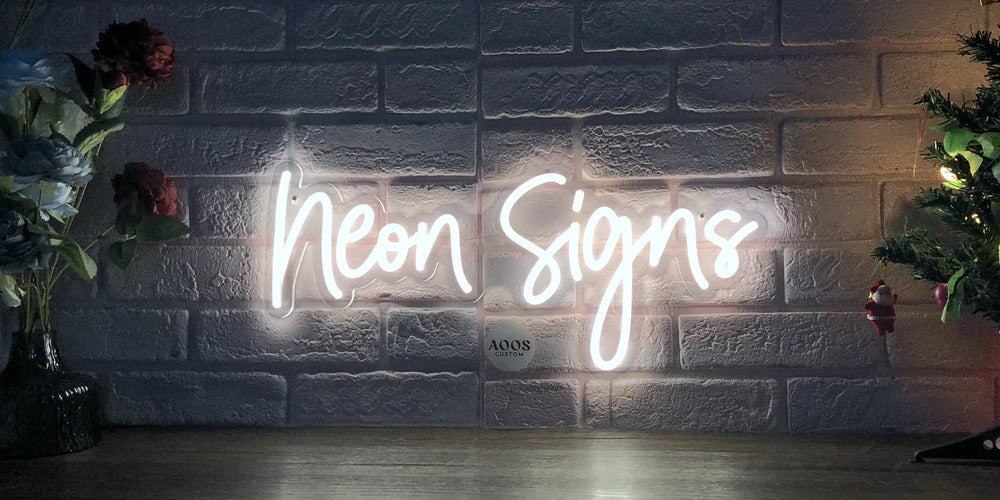
LED neon tube encases the LEDs in a thick diffusing silicone jacket. The dots disappear into an even line of light along the whole run. It is designed to be looked at directly, which is why it can be bent into letters and mounted face on.
Side by side
| LED strip | LED neon sign | |
|---|---|---|
| Meant to be | Hidden | Seen |
| Appearance lit | Individual dots | Continuous line |
| Can form letters | No, not neatly | Yes, that is the point |
| Room lighting | Good | Ambient only |
| Mounting | Adhesive backing into a channel | Bonded to a shaped board |
| Cost | Low per meter | Higher, and it is a made object |
Can you make a sign out of strip?
People try. It is worth being honest about why it disappoints.
- ✗ Strip only bends one way. It flexes along its flat plane, so curves in a letter kink rather than turn.
- ✗ You can see every LED. Close up, a word made of strip is a row of bright points, not a glowing stroke.
- ✗ Cut points are fixed. Strip can only be cut every few centimeters, which is coarse for letterforms.
- ✗ The adhesive backing fails on a vertical. It is meant to sit in a channel, not to hold itself up.
What about neon flex sold by the meter?
That is the same silicone jacketed tube we bend, sold in a reel. The material is right; the work is the missing part. A sign is that tube bent to a drawn path, cut, joined, wired, sealed and bonded to a board cut to the shape of the letters. That is what you are buying when you buy a sign, and it is why a reel of flex is cheap and a finished sign is not.
Buy strip for light and a sign for a statement, and do not try to make either do the other's job. If your instinct is to make a sign from a reel of flex, price your own time honestly first. Most people who go that way end up ordering a made sign afterwards, having spent the difference on a weekend.
Frequently asked questions
What is the difference between LED neon and LED strip lights?
LED strip is a flat circuit board with visible individual LEDs, designed to be hidden in a channel so you see the light rather than the source. LED neon encases the LEDs in a thick silicone jacket that diffuses them into one continuous line, so it can be looked at directly and bent into letters.
Can I make a neon sign out of LED strip lights?
Not convincingly. Strip only flexes in one plane, so curves kink instead of turning, the individual LEDs stay visible as bright dots, and cut points are only every few centimeters, which is too coarse for letterforms. The adhesive backing also does not hold on a vertical surface.
Which is brighter, LED neon or LED strip?
Bare strip puts out more raw light, because the silicone jacket on neon tube absorbs some of it. That jacket is the point though: it trades output for an even glow with no visible dots. Strip is the better room light and neon is the better thing to look at.
Is neon flex sold by the meter the same material?
Yes, it is the same silicone jacketed tube. What a reel does not include is the work: bending to a drawn path, cutting, joining, wiring, sealing and bonding to a board cut to the shape of the letters. That is the difference in price.
Can a neon sign light a room?
It contributes ambient light and it makes a real difference to the feel of a room at night, but it is not a room light. Use strip, lamps or ceiling lighting for illumination and a neon sign for the focal point. The two work well together.
We have made neon since 1998, and we still make it ourselves. If something here does not answer your question, ask us.