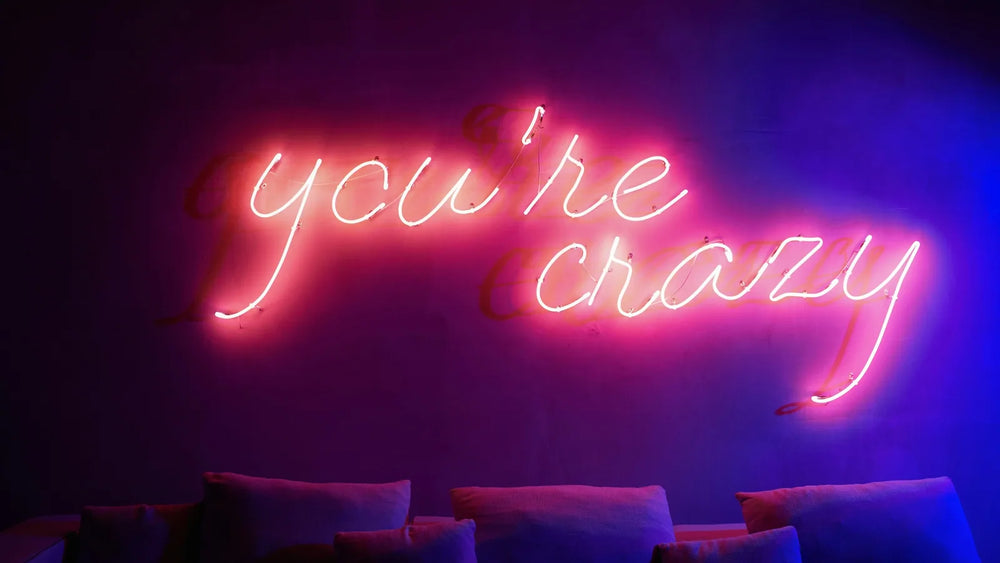
A real glass piece costs more than the same design in LED, and takes longer to make. The difference is skilled hand labour, not materials, which is why it does not shrink on larger pieces the way volume discounts usually do.
The choices that move the number most, in order: overall size, number of colors, and how tight the curves are. Lead time is driven by the same things plus the aging the tube needs before it can leave.
What the money is buying
It is worth being specific about this, because "handmade" is used loosely enough in retail that it has stopped meaning much.
A glass neon sign is made by a person standing at a burner, heating straight lengths of tubing until the glass softens, and bending each curve by hand against a full size pattern drawn in reverse. While bending, they blow gently into the tube to stop the walls collapsing at the bend. There is no machine step. There is no way to do it faster with volume.
After bending, the tube is fitted with electrodes, sealed, pumped down to vacuum, run under heavy current to drive out impurities, filled with a measured quantity of gas at low pressure, sealed permanently and then run for a period to stabilise before anyone will sell it.
What moves the number
Size, as always
More tube run and more bends. This is the dominant factor, exactly as it is in LED.
Number of colors
This one costs more in glass than buyers expect. In LED, another color means another run of flex. In glass, each color is a physically separate hand-made section, with its own bending, its own electrodes, its own pumping and filling cycle. A two color glass sign is closer to two signs than to one sign with an option added.
How tight the curves are
Tight radii, small counters inside letters and fine script detail are all harder to bend without collapsing the tube, and they raise the reject rate. A design that looks equally complex on screen can be twice the work depending on the geometry.
If a glass quote comes back higher than you hoped, the most effective single change is usually dropping to one color, not shrinking the piece. Reducing size loses presence; going monochrome in glass often looks better anyway, because a single continuous color is what makes the medium read as neon rather than as a picture made of light.
Lead time, and why it cannot be rushed
Glass takes longer than LED and the difference is structural rather than a scheduling problem.
- ✓ Pattern and bending is hand work whose duration scales with the number and difficulty of bends.
- ✓ Processing means pumping, bombarding and filling, each of which takes the time it takes.
- ✓ Aging means running the finished tube to stabilise it. Skipping this is how a sign fails early, so it is not a step to compress for a deadline.
If you have a hard date, say so at quote stage rather than after. Sometimes the honest answer is that the date is achievable in LED and not in glass, and it is better to hear that while you can still choose.
Getting a glass look on a smaller budget
Three options that are genuinely worth considering, rather than the usual advice to just buy less.
- One color, larger piece. A single color glass sign at a generous size will almost always look better than a small multi-color one at the same price.
- Glass for the focal element only. A glass logo or single word as the centerpiece, with any supporting copy handled another way, concentrates the spend where the medium is visible.
- LED, with the difference put into size. For a wall people view from across a room, a noticeably larger LED piece often reads better than a smaller glass one. That is a real recommendation, not a fallback. The comparison is in glass versus LED.
What a suspiciously cheap glass quote usually means
Since the cost is labour, a quote well below the market is a quote with less labour in it. In practice that shows up as rushed or skipped aging, thinner or reused tubing, shortcuts in the pumping stage that leave impurities and shorten life, or a piece that is quietly LED sold under a glass description.
A fair test: ask what gas is in each color. Anyone actually making glass can answer immediately, because neon gives the red-orange and everything else is argon with coatings. If the answer is vague, you may not be buying glass at all. The background is in what is real glass neon.
Getting a real number
Send the design or a reference image with the size you have in mind. We will come back with a written price, the palette shown in the actual gases and coatings available rather than as screen colors, and an honest lead time. If the project would be better served in LED, or if your date only works in LED, we will say so before you commit.
Get a free quote, or see custom real glass neon signs.
Frequently asked questions
How much does a real glass neon sign cost?
Glass is quoted per design rather than from a price list, because the cost is driven by the tube run, the number of separate hand-made color sections and how difficult the curves are. It comes in above the same design built in LED, and the gap is skilled hand labour rather than materials. Send the design and the size you have in mind for a written price.
Why does each extra color cost so much in glass?
Because in glass each color is a physically separate hand-made section, with its own bending, electrodes, pumping and gas filling cycle. A two color glass sign is closer to two signs than to one sign with an option added. In LED, by contrast, another color is simply another run of flexible tube, which is why the increments there are much smaller.
How long does a real glass neon sign take to make?
Longer than LED, and the difference is structural rather than scheduling. Bending is hand work that scales with the number and difficulty of curves, the tube then has to be pumped, purified under current and gas filled, and finally it is run for a period to stabilise before it can be crated and shipped. That aging step is what stops a sign failing early, so it is not something to compress for a deadline.
What is the cheapest way to get a real glass neon sign?
Drop to a single color rather than shrinking the piece. Color count is the most expensive variable in glass, and a single continuous color usually suits the medium better anyway. Restricting glass to the focal element, with supporting copy handled another way, is the next best option. If neither gets you there, LED with the difference put into a larger size is often the better room.
Why should I be careful with a very cheap glass neon quote?
Because the cost of glass is labour, so a quote well below the market has less labour in it. That typically shows as rushed or skipped aging, thinner or reused tubing, or shortcuts in the pumping stage that leave impurities and shorten the sign's life. It can also mean the piece is LED sold under a glass description. Asking which gas produces each color is a quick way to test whether you are talking to someone who actually makes it.
We have made neon since 1998, and we still make it ourselves. If something here does not answer your question, ask us.