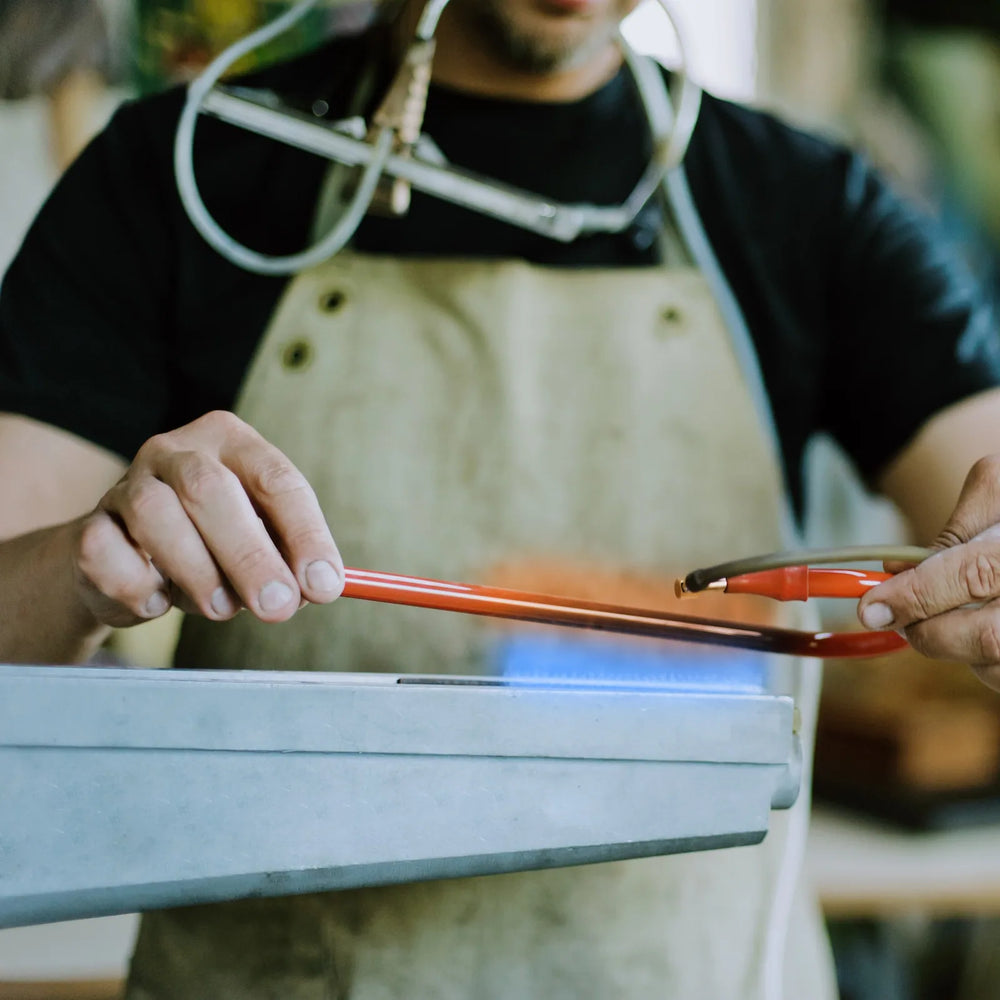
A glass neon sign is made in six stages: pattern, bending, electrodes, pumping, filling, aging. None of them is automated. The bending is done by hand over an open flame against a full size drawing, and the bender blows into the tube while shaping it to stop the walls collapsing.
The stage that decides whether a sign lasts is not the one that looks impressive. It is the pumping, and it is the first thing cut when a quote is too cheap.
1. The pattern
The design is drawn full size on heat-resistant paper, and drawn in reverse. The bender works from behind the glass, so a mirrored pattern is what lets them check the shape against the drawing as they go.
This is also where a design meets reality for the first time. Sharp interior corners, very tight counters inside letters like a lowercase e, and closely spaced parallel strokes all have to be reconsidered here, because a tube has a minimum radius it can take without deforming. A design that works on screen may need adjusting before a single piece of glass is heated.
2. Bending
Straight lengths of tubing are heated over burners until the glass reaches a working temperature, then bent by hand against the pattern.
Different burners suit different jobs: broad ribbon burners for long sweeping curves, narrower crossfires for tight corners. Longer designs are made as several sections and joined, and every join is another opportunity for a leak, which is why an experienced maker plans the splices at the least visible points.
This stage is where the years go. Bending glass is a physical skill with a long apprenticeship, and it is the reason glass is priced as labour rather than as production.
3. Electrodes
An electrode is fused into each end of the finished tube and the assembly is sealed. These are the metal parts you can see at the ends of a glass sign when it is switched off, and they are the components that most often set the eventual lifespan of the piece.
4. Pumping and bombarding, the stage that decides lifespan
The tube is connected to a manifold and the air is pumped out. Then a heavy current is passed through it, which heats the glass and the electrodes hard enough to drive out moisture and impurities absorbed into the surfaces.
This stage is invisible in the finished product and it is the first thing shortened when someone is competing on price. A tube that was not properly purified will look identical on day one and will darken, dim or fail years earlier than it should. When we say a suspiciously cheap glass quote is a warning rather than a bargain, this is mostly what we mean.
5. Filling
A measured quantity of gas is admitted at low pressure and the tube is sealed permanently. Which gas depends on the color you asked for.
Neon produces the familiar red-orange and nothing else. Argon on its own is a faint lavender; argon with a trace of mercury glows blue, and that blue is what excites phosphor coatings inside the tube to produce the rest of the palette. So the color is fixed at this moment, permanently, by a physical choice. There is no adjusting it afterwards. That is covered further in what is real glass neon.
6. Aging
The finished tube is run for a period before anyone will sell it. This settles the gas and the electrodes and surfaces early failures while the piece is still in the workshop rather than on your wall.
It also takes time that cannot be compressed, which is a large part of why glass lead times are longer than LED. If you have a hard date, that is worth raising at quote stage. Sometimes the honest answer is that the deadline works in LED and not in glass.
Why no two are identical
Every bend is a hand judgement made in a few seconds while the glass is at temperature. Two pieces from the same drawing will differ slightly in the curve of a stroke or the spacing of a letter.
For most buyers this is the appeal. It is worth flagging if you need several units to match closely across locations, because that is a much harder brief in glass than in LED and it should be priced and scheduled as one.
Which is also why it can be repaired
Because a glass sign is an assembly of hand-made sections rather than a sealed electronic unit, a damaged section can be re-bent, re-fitted, re-pumped and re-filled while the rest of the piece continues. A cracked tube is a repair, not a write-off.
This is a genuine difference in what you own. A well maintained glass sign is a decades-long object, and the vintage neon trade exists precisely because these things can be brought back.
Commissioning a piece
Send your design or a reference image. We will come back with a written price, the palette in the actual gases and coatings available rather than as screen colors, and an honest lead time. If your design has geometry that will fight the glass, we will tell you at drawing stage rather than after the first bend.
Get a free quote, see custom real glass neon signs, or read cost and lead time.
Frequently asked questions
How is glass neon made?
In six stages. A full size pattern is drawn in reverse, straight tubing is heated over burners and bent by hand against it, electrodes are fused into each end, the tube is pumped down to vacuum and purified under heavy current, a measured amount of neon or argon is admitted at low pressure and sealed in, and the finished tube is run for a period to stabilise it. There is no automated step, which is the whole of the difference between glass neon and LED neon.
Why do neon benders blow into the tube?
Because heated glass at a bend wants to collapse inward. Blowing gently through a hose attached to the end of the tube holds the wall out so the bore stays even through the curve. If it pinches, the gas flow is restricted and the finished sign shows a dim or uneven section at that point.
What makes one glass neon sign last longer than another?
Mostly the pumping stage. Before filling, the tube is heated under heavy current to drive out moisture and impurities absorbed into the glass and electrodes. A tube that was not properly purified looks identical when new but darkens, dims and fails years earlier. Because that stage is invisible in the finished product, it is the first thing shortened when a maker is competing on price, which is why a very low glass quote is worth reading as a warning. The rest of that picture is in glass neon cost and lead time, and if a sign we made does fail it is covered by free repair under warranty.
Can two glass neon signs be made identical?
Not exactly. Every bend is a hand judgement made in seconds while the glass is at working temperature, so pieces from the same drawing differ slightly in curve and spacing. If you need several units to match closely across locations, say so up front, because it is a much harder brief in glass than in LED and needs to be priced and scheduled accordingly. Flag it when you ask for a quote rather than after the first piece is bent.
Why do some designs have to be changed before bending?
Because a tube has a minimum radius it can take without deforming. Sharp interior corners, very tight counters inside letters, and closely spaced parallel strokes all have to be reconsidered at the pattern stage. Overall size feeds into this, since a small piece leaves no room for the bends a design needs, so it helps to settle what size sign you need early. A design that works on screen may need adjusting before any glass is heated, which is why the drawing review happens before fabrication rather than during it.
We have made neon since 1998, and we still make it ourselves. If something here does not answer your question, ask us.