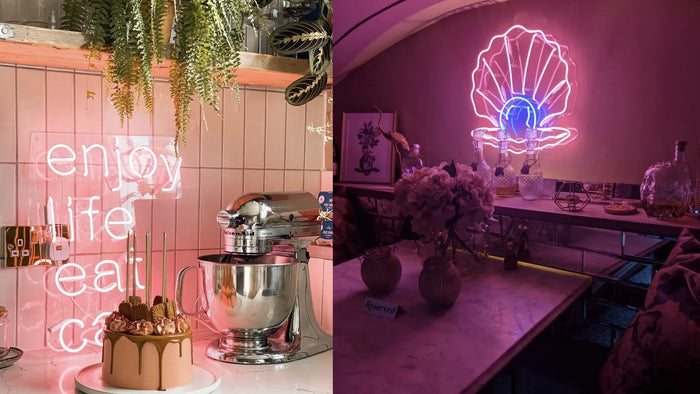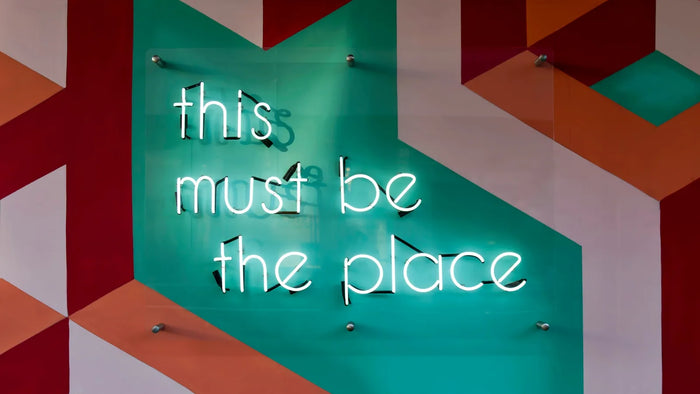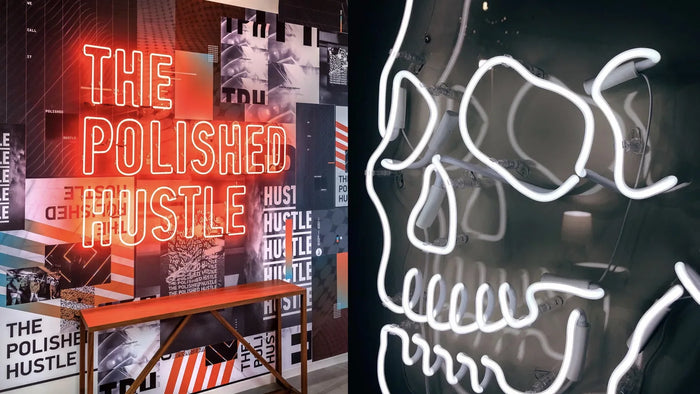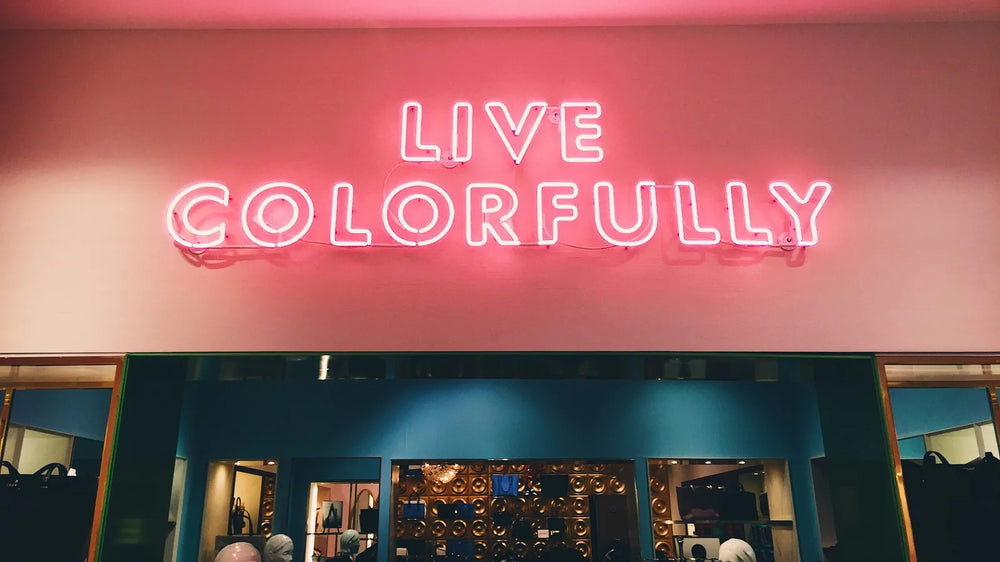
Glass wins on authenticity, depth and repairability. LED wins on cost, weight, durability, shipping, outdoor use and color control. Neither is the better product in general, and anyone who tells you otherwise is selling one of them.
Choose glass when people will look at the piece closely and the medium is part of the point. Choose LED when the sign has to travel, hang in a home, go outdoors, change color, or come in at a lower number.
The comparison, without the sales angle
| Real glass neon | LED neon | |
|---|---|---|
| What makes the light | The gas inside the tube | LEDs inside a silicone tube |
| Power | High voltage via transformer | 12V DC |
| Color | Fixed permanently by gas and coating | Any color, and color changing available |
| Dimming | Limited | Standard |
| Weight | Heavy | Light |
| In transit | Fragile, needs crating | Robust |
| Outdoors | Possible, specialist install | Straightforward, IP67 available |
| When it fails | Repairable, often decades of service | Repairable, rated 50,000 hours |
| Smallest detail | Limited by tube diameter and bending | 5 cm minimum letter height |
| Cost | Higher, priced as skilled hand labour | Lower |
What you actually see in person
The difference is real, and it is not mainly about brightness.
In a glass tube the gas glows throughout the whole volume, so the light has depth: the tube reads as a lit object rather than as a lit surface, and the color is continuous along its length. In LED neon, individual emitters sit behind a silicone diffuser. Modern LED neon is very good, and at a distance most people cannot tell. Up close, and particularly at the ends of strokes and at tight curves, a trained eye can.
Switched off, the difference is obvious either way. Glass reads as clear or colored glass tubing with visible electrodes. LED neon reads as a white or pale silicone tube on an acrylic backboard.
Color is where the two diverge most
This is the difference that decides more projects than cost does, and it is the one buyers are least often told about.
A glass tube is one color, permanently, because the color is a property of the gas and coating sealed inside it. Neon gas gives the red-orange; everything else comes from argon with phosphor coatings or tinted glass. The palette is a fixed set of real tubes, not a picker.
LED neon has no such constraint. Any color, color changing, dimming and remote control are all normal. If your brief includes matching a specific brand color exactly, or the sign changing color, glass is not a compromise on that requirement, it simply cannot do it.
Why glass costs more
Not materials. Labour and skill.
Every bend in a glass sign is made by hand over a flame against a full size pattern, by someone who has spent years learning to do it. Each color is a physically separate hand-made section, with its own bending, electrodes and gas filling cycle. The tube then has to be evacuated, purified under heavy current, gas-filled and aged before it is fit to sell. There is no version of this that gets faster with volume in the way LED fabrication does.
Lead times are longer for the same reason. A glass piece is made to order by a person, not assembled from stock parts. Both mediums are quoted per design, so the honest way to see the gap for your project is to ask for both.
We build both, so we have no reason to push you either way. A useful way to frame it: if the premium for glass feels obviously worth it once you picture where the piece will sit and how closely people will see it, buy glass. If you find yourself justifying it, buy LED and put the difference into making the sign bigger. In practice most home, wedding and gift buyers are better served by LED, and most bars, restaurants, galleries and collectors are better served by glass.
Shipping and installation are not a footnote
Glass is crated for fragile transit and needs to be handled accordingly at the other end. It runs at high voltage, so installation is specialist work and it is not a sign to rewire casually. Once it is up and left alone, none of this matters. If the piece will move between venues, be installed by whoever is available, or ship a long distance, those factors move from footnote to decisive.
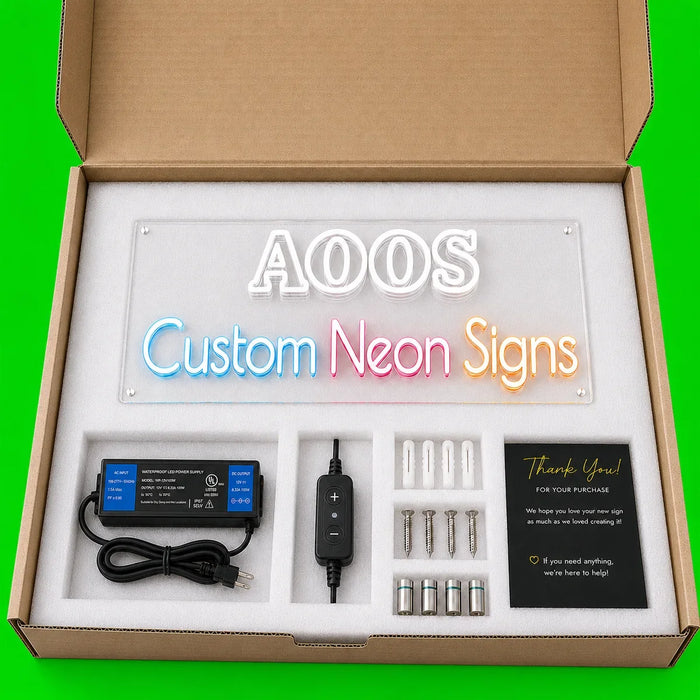
LED neon travels well, mounts with ordinary fixings and runs on low voltage. For exterior work our LED signs are built and tested to IP67, and we can supply the test report.
Four questions that decide it
- How close will people be? Within a few feet, the medium is visible and glass earns its premium. Across a room, far less so.
- Does the sign need to move? If it travels, LED.
- Does the color need to change, dim, or match a brand reference exactly? If yes, LED, because glass cannot.
- Would you rather have glass at this size, or LED at a noticeably larger one? That is the real trade, and for a lot of walls the larger LED piece is the better room.
Get both quoted
If you are genuinely undecided, send the design and ask for both. Seeing the same artwork priced as glass and as LED, with an honest note on where each would look better, settles it faster than any comparison page can.
Get a free quote. Background on the medium is in what is real glass neon, and the LED side of the catalog is in the LED neon guides.
Frequently asked questions
What is the difference between real glass neon and LED neon?
Real glass neon is hand-bent glass tubing filled with neon or argon gas and lit by a high voltage transformer, so the gas itself produces the light. LED neon is a flexible silicone tube containing LEDs, mounted on an acrylic backboard and run at 12V DC. Glass gives more depth and authenticity and is repairable over decades; LED is lighter, cheaper, robust in transit, can change color and is straightforward outdoors.
Why is real glass neon more expensive than LED?
The cost is skilled hand labour rather than materials. Every bend is made by hand over a flame against a full size pattern, each color is a physically separate hand-made section with its own electrodes and filling cycle, and the tube must then be evacuated, purified under heavy current, gas-filled and aged. None of that gets faster with volume the way LED fabrication does, which is also why lead times are longer.
Can you tell the difference between glass neon and LED neon?
Up close, yes, particularly at the ends of strokes and on tight curves, because in glass the gas glows through the whole volume of the tube while LED neon lights a diffuser from behind. At a distance, or above head height across a room, most people cannot. The closer the viewer will be, the more the choice of medium matters.
Can real glass neon be used outdoors?
It can, but it is specialist work. Glass is fragile, runs at high voltage and needs an installation suited to that. Most exterior projects use LED instead for durability, weight and simpler servicing. Our LED signs for exterior use are built and tested to IP67 and we can supply the test report.
Which lasts longer, glass neon or LED neon?
Both are repairable rather than disposable, so the honest answer is that it depends on care rather than on medium. Our LED signs are rated at 50,000 hours, and in practice power supplies and connections fail before the LEDs do. A well maintained glass sign can serve for decades and can be re-bent and re-filled when a section fails, which is why a vintage neon market exists.
We have made neon since 1998, and we still make it ourselves. If something here does not answer your question, ask us.